Views: 0 Author: Site Editor Publish Time: 2026-07-08 Origin: Site
Material selection dictates project viability on the shop floor. Traditional fabrication methods like welding steel or CNC machining solid billets present severe limitations. You deal with high labor demands, inconsistent tolerances across batches, and excessive assembly times that bottleneck production schedules. When structural integrity and component weight clash, standard fabrication often fails to scale efficiently. Aluminum Extrusion solves these issues by offering a highly repeatable, customizable manufacturing process. It consolidates multi-part assemblies into single, high-strength profiles. This eliminates the need to weld or bolt multiple pieces together. We will evaluate how extruded components streamline production, improve structural integrity, and reduce overall component weight for heavy-duty applications.
Consolidated Assembly: Custom aluminum extrusions eliminate the need for complex joining processes by integrating hinges, screw bosses, and mounting tracks directly into the profile design.
Favorable Strength-to-Weight Ratio: The process delivers aerospace-grade structural integrity at a fraction of the weight of steel, reducing long-term energy and transportation costs.
Cost-Effective Tooling: Compared to plastic injection molding or die casting, aluminum extrusion dies represent a lower barrier to entry for custom industrial components.
Material Versatility: Selecting the correct alloy (typically 6000-series) and temper is the primary driver of success for industrial aluminum profiles in high-stress environments.
The physical process involves forcing a preheated aluminum billet through a customized steel die with a predetermined cross-sectional profile. You heat the alloy billet to its plastic deformation range, typically between 400°C to 500°C (750°F to 930°F). This specific temperature window enables smooth material flow without melting the metal. A hydraulic ram applies massive pressure, often exceeding several thousand tons, forcing the softened metal through the tooling. This pressure ensures the metal achieves uniform structural properties and grain alignment as it exits the press onto the runout table.
Once the profile exits the die, it undergoes rapid cooling or quenching. The quench rate directly impacts the final mechanical properties of the material. Water quenching or forced air cooling locks the alloying elements into a solid solution. After cooling, the profiles are stretched to relieve internal stresses and correct any minor bowing or twisting that occurred during the thermal cycle. Finally, the profiles are cut to length and moved to artificial aging ovens to achieve their final temper.
Die selection directly impacts cycle time, design freedom, and production efficiency. Simple solid dies consist of flat steel plates used for solid cross-sections. Complex hollow or porthole dies utilize multi-part tooling with internal mandrels to create inner chambers and voids. The metal separates as it flows around the mandrel and welds back together inside the die chamber before exiting.
Tooling engineers use high-quality H13 hot-work tool steel to withstand extreme thermal and mechanical fatigue. H13 steel maintains its hardness at elevated temperatures, ensuring consistent profile quality over long production runs. Die wear is a constant reality on the extrusion line. Regular maintenance, nitriding treatments, and careful monitoring of the bearing surfaces are required to keep dimensional tolerances within acceptable limits.
You face a strategic choice between sourcing off-the-shelf Industrial Aluminum Profiles and investing in custom dies for proprietary OEM components. Standard profiles, such as modular T-slot framing, offer immediate availability. They work well for machine guarding, temporary fixtures, and rapid prototyping. However, they often carry excess weight and require additional fastening hardware.
Custom profiles allow for design consolidation. You can optimize material usage specific to a product's exact load requirements. By designing a custom die, you eliminate unnecessary wall thickness, integrate specific mounting features, and reduce the overall part count of your final assembly. The initial tooling investment pays off rapidly through reduced assembly labor and lower per-part material costs.
Understanding geometric constraints prevents die failure and excessive scrap. Proper DFM ensures the profile flows evenly through the die. Unbalanced metal flow causes twisting, tearing, and rapid tool wear.
Wall Thickness Variations: Keep wall thicknesses as uniform as possible. Sudden transitions from thick to thin walls cause uneven cooling and distortion.
Hollow vs. Solid Profiles: Hollow profiles require more complex porthole dies. Ensure internal voids have sufficient clearance for the mandrel supports.
Balanced Extrusion Ratios: The ratio of the billet cross-section to the profile cross-section must fall within optimal limits to ensure proper mechanical working of the metal.
Circumscribing Circle Size (CCS): The entire profile must fit within a specific circle diameter dictated by the press size. Profiles exceeding the CCS require larger, less common extrusion presses.
Tongue Ratios: Avoid deep, narrow channels. The steel tongue creating the channel in the die can snap off under high extrusion pressure if the ratio of depth to width is too high.
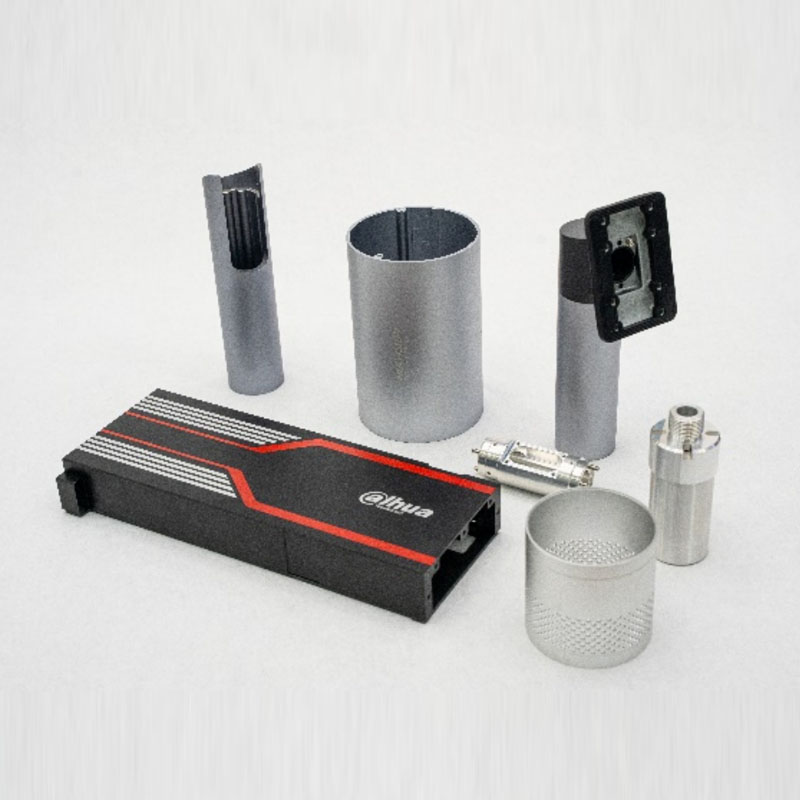
Extruded components form the backbone of modern aircraft. You will find them in wing structures, fuselage structural skins, landing gear structural parts, and interior seating frameworks. Success requires strict adherence to AS9100 standards. Manufacturers utilize high-strength 2000 or 7000-series alloys, which offer exceptional fatigue resistance. Rigorous non-destructive testing (NDT), including ultrasonic and eddy current inspections, ensures zero internal defects.
The automotive sector relies on extrusions to shed vehicle weight without sacrificing safety. Applications include EV battery enclosures, crash management systems, and lightweight chassis components. Success criteria focus on high energy absorption capabilities during impact. Precise dimensional tolerances are mandatory for automated robotic welding lines. Excellent corrosion resistance ensures longevity in harsh road environments.
Shop floors utilize these materials extensively. Workbenches, inspection tables, machine guarding, and linear motion tracks frequently rely on extruded framing. Modularity allows for rapid reconfiguration of assembly lines. Compatibility with standard fastening hardware and high rigidity under dynamic loads are critical for maintaining precision in robotic cells.
Solar panel mounting frames and wind turbine internal structural supports demand durable materials. Extruded parts dominate this sector. Long-term weatherability and minimal maintenance requirements define success. The ability to scale production for high-volume, rapid deployment allows energy companies to build massive solar arrays efficiently.
Selecting the right manufacturing process requires a hard look at material waste, labor, and cycle times. Extrusion competes directly with machining, welding, and roll forming.
Manufacturing Method | Primary Advantage | Primary Disadvantage | Best Use Case |
|---|---|---|---|
Aluminum Extrusion | Consolidates parts, low material waste | Limited to constant cross-sections | Linear structural components, heat sinks |
CNC Machining | Extreme precision, complex 3D geometry | High material waste, slow cycle times | Intricate brackets, engine components |
Welded Steel Assemblies | High absolute tensile strength | Heavy, requires corrosion protection | Heavy machinery frames, building structures |
Roll Forming | Extremely fast for high volumes | Cannot create complex internal cavities | Thin-walled tubing, simple roofing panels |
Machining offers tighter tolerances for highly complex 3D parts. You can hold dimensions to fractions of a thousandth of an inch. However, machining a solid billet generates massive amounts of chips, wasting material and driving up costs. Extrusion drastically reduces material waste. You only pay for the metal in the final profile. For components with a consistent cross-section, extruding the near-net shape and performing minor secondary machining is far more efficient.
Steel provides higher absolute tensile strength, making it the default for heavy construction. But steel is heavy and rusts. Aluminum extrusion eliminates weld-distortion risks entirely. You do not have to worry about heat-affected zones warping your frame. It requires zero secondary anti-corrosion coating, saving a step in production. Most importantly, it cuts weight by roughly 60%, which is critical for transportation and moving machinery.
Roll forming pushes sheet metal through a series of rollers to bend it into shape. It is faster for thin-walled, simple shapes in massive volumes. However, roll forming cannot create complex internal cavities or varying wall thicknesses within a single profile. Extrusion allows you to put material exactly where you need it for structural support while leaving non-load-bearing areas hollow.
The 6000-series alloys dominate the extrusion market due to their excellent extrudability and mechanical properties. The 6063 alloy is preferred for intricate shapes and architectural finishes. It flows easily through complex dies and accepts anodizing exceptionally well. The 6061 alloy is mandatory for high-stress structural applications. It contains higher levels of magnesium and silicon, providing superior yield strength.
Artificial aging dictates the final temper. Temper designations like T4, T5, and T6 indicate the thermal treatment applied after extrusion. A T6 temper involves solution heat treating and artificial aging to achieve maximum tensile strength. Understanding these tempers is necessary because they impact post-extrusion machinability and bending characteristics.
Extrusion produces long linear lengths. Post-extrusion machining is often necessary to cut the profiles to precise lengths, drill mounting holes, and mill specific slots. CNC routing centers handle these secondary operations efficiently.
Surface treatments protect the raw aluminum and improve aesthetics. Anodizing creates a controlled oxide layer on the surface. Type II anodizing provides standard wear resistance and color options. Type III hardcoat anodizing delivers extreme wear resistance and electrical insulation for harsh environments. Powder coating offers a durable, thick layer of environmental protection and is available in virtually any color.
Extrusion is a thermal-mechanical process. Standard tolerances are looser than precision machining. If you expect CNC-level tolerances straight off the press, you will fail. Designate critical-to-function (CTF) dimensions early in the design phase. Plan for secondary CNC machining only on the specific surfaces that require tight fits.
Highly unbalanced profiles or extreme tongue ratios cause die failure during production. A broken die halts your supply chain immediately. Partner with an extrusion manufacturer during the CAD phase. Let their tooling engineers optimize your wall thicknesses and transition radii before cutting steel.
Custom extrusions often require high Minimum Order Quantities (MOQs). Presses run efficiently only when pushing thousands of pounds of metal. This ties up capital in inventory. Negotiate blanket orders with your supplier to spread out deliveries. Evaluate domestic versus offshore lead times carefully. Standardize your designs to utilize off-the-shelf profiles where custom dies are not strictly required to keep inventory lean.
Audit your current multi-part assemblies to identify components that can be consolidated into a single extruded profile.
Select standard modular profiles for rapid prototyping, temporary fixtures, and factory infrastructure projects.
Invest in custom extrusion dies for proprietary, high-volume OEM components where weight reduction directly drives product performance.
Define your critical-to-function dimensions and specify secondary CNC machining only where standard extrusion tolerances are insufficient.
Contact a technical sales engineer with your CAD drawings to initiate a formal Design for Manufacturability review before finalizing your alloy selection.
A: Tooling costs range from $500 to $5,000 depending on profile size and complexity. Solid dies are significantly cheaper than hollow dies. This represents a very low barrier to entry compared to plastic injection molding dies, which often cost tens of thousands of dollars.
A: The maximum size is restricted by the press tonnage and the circumscribing circle size (CCS). Most standard presses handle profiles up to 10 inches in diameter. Massive heavy-duty presses can extrude profiles exceeding 20 inches for specialized aerospace or marine applications.
A: Yes, 6000-series alloys are readily weldable using TIG or MIG processes. However, welding creates a heat-affected zone that causes a localized loss of temper and strength. You must account for this strength reduction in your structural calculations.
A: Lead times typically range from 4 to 8 weeks. This timeline includes die design, cutting the tool steel, running an initial sample batch, and completing quality inspections before moving into full-scale production.
A: Aluminum profiles provide a superior strength-to-weight ratio and natural corrosion resistance. They eliminate the need for welding and painting. Steel offers higher absolute tensile strength but is significantly heavier and requires ongoing maintenance to prevent rust.
A: The 6061-T6 alloy is the industry standard for general high-stress structural use. For extreme stress applications, such as aerospace components, 7000-series alloys like 7075 are preferred due to their exceptional yield strength and fatigue resistance.


